Reward tiers and pricing that convert without killing your margin
Your reward tiers are the thing people actually buy. Here is how to build an offer backers feel almost silly saying no to, and still make money on every order.
Here is something most first-timers get backwards. They pour every ounce of energy into the product and treat the rewards as a box to tick the night before launch. Don't. Your reward tiers are your campaign. They are the actual thing people buy. I have watched an average product with a sharp, no-brainer offer outperform a better product with a confusing, overpriced one. Every time.
Think about how you feel when you land on a Kickstarter page for something you like, the pricing is clear, the early bird is almost sold out, and the deal is obviously good. You back it without overthinking. Now think about landing on a page with twelve tiers, three color variants, two bundle combinations, and prices ending in .97. You close the tab. Your job is to design the offer that gets the first reaction.
Think of your rewards as a staircase
Every step up costs the backer a little more and hands them a little less of a discount, because the earliest steps are a reward for trusting you before anyone else did. For a single-product campaign with a $99 retail price, a clean ladder looks like this: a Super Early Bird at $59 for the first 100 backers, 40% off and gone in hours by design. An Early Bird at $64 for the next 250. A Campaign Special at $69 with no limit. And at the bottom, the retail price itself, $99, which almost nobody will choose.
{{ ladderSvg }}Leave that $99 there. Its only job is to make every tier above it look like a steal. That is price anchoring, and it is quietly the most important number on your whole page. Remove it and the $69 tier becomes "a $69 product." Keep it and the same tier becomes "$30 off."
Quantity limits are doing real work
The numbers you choose matter more than people realize. "First 100" feels scarce and exclusive. "First 10,000" feels like a tactic. For a first campaign, cap the Super Early Bird at a number that reflects real scarcity: enough to cover your most committed pre-launch VIPs, tight enough that it visibly sells down. When a visitor sees "47 remaining out of 100," that counter is persuading them. I have seen campaigns change nothing except adding a visible remaining-count to the best tier, and conversion on that tier jumped the same day. Scarcity, when it is real and visible, is one of the strongest forces in buying behavior. Use it honestly.
A note on international pricing
If a meaningful share of your audience is outside your home country, check whether your base price translates cleanly. A $69 product that converts to about €64 or £55 is fine. One that lands at €67.42 because you priced in dollars without thinking signals that nobody considered international buyers. Kickstarter supports region-specific pricing natively. It is a small detail that international backers notice.
Name the tiers like they mean something
"Super Early Bird, $59" is fine. "Pioneer," "Founder" or "First 100" does something more: it makes the backer feel like part of a select group rather than someone buying at a discount. The best tier names combine the deal with an identity. "The Explorer Edition" and "Tier 3" can be the same price, but only one has personality.
Keep the naming consistent with your brand's tone. A premium minimalist product uses clean, confident names. A playful gadget can have fun. A game names tiers after in-world concepts. Whatever you choose, the name should telegraph relative value. Your best deal gets the name that sounds most exclusive and time-limited, so urgency is communicated before the backer reads a word of the description.
The four levers you are really pulling
Good pricing is not a guess. Underneath that ladder you are pulling four levers, and you can feel each of them working on you the next time you shop.
{{ leversSvg }}Anchor. Show the retail price so the discount is obvious. Scarcity. Cap the best tiers; "only 100" beats "on sale." Urgency. A deal that ends gets people off the fence today instead of next week. Value. Stack extras so the price feels like a bargain even before the discount is applied.
Most weak offers are missing two of the four. A page with a discount but no cap and no deadline has an anchor and nothing else. A page with "limited time" but no retail price has urgency but no anchor, so the backer has no way to know whether the deal is good. Check all four before you publish.
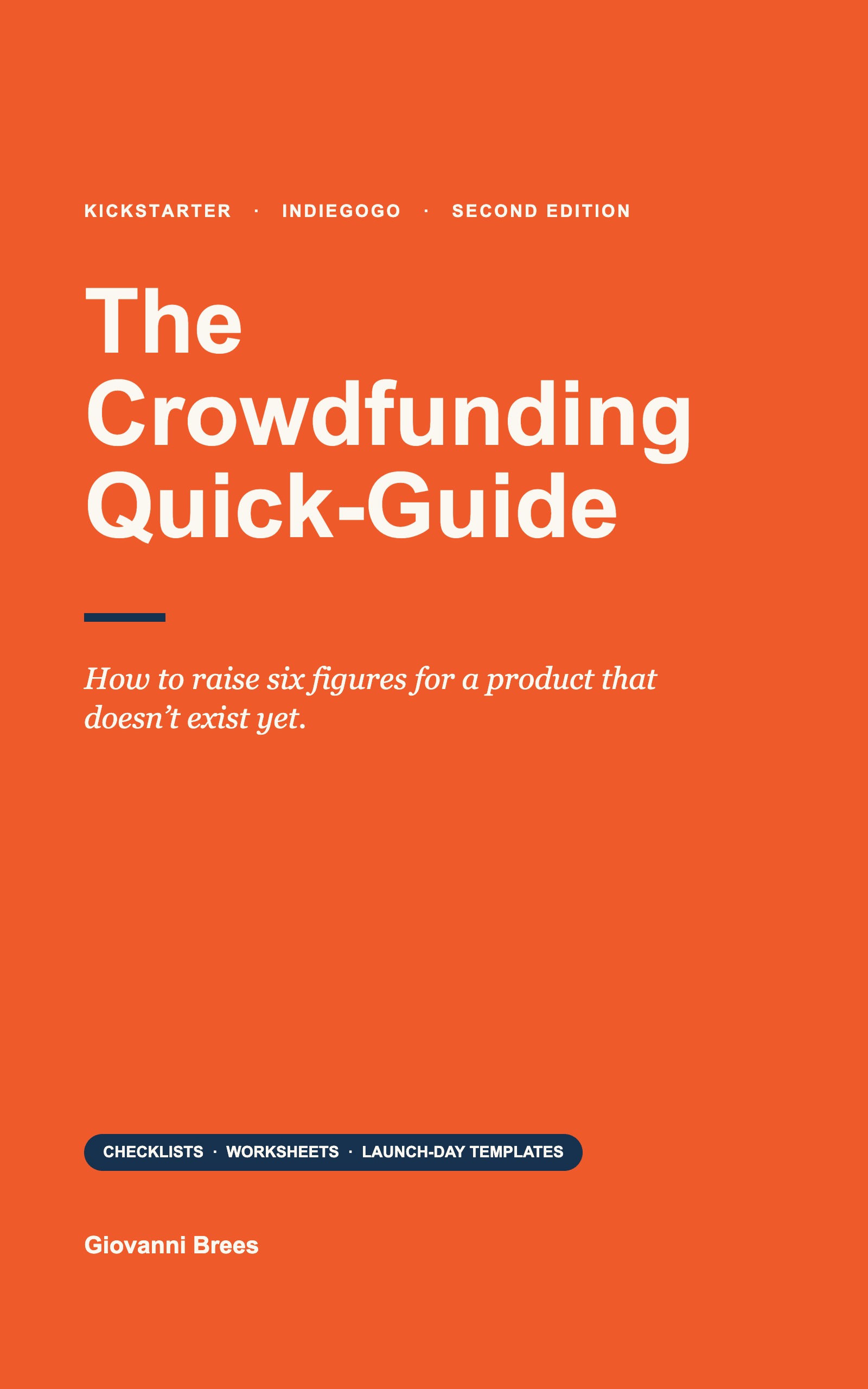
31 chapters, 7 appendices, and a fill-in template for every decision in this article.
Get the book on Amazon →The secret weapon: the reservation deposit
Long before launch day, don't just collect emails. Ask people to put down a small, fully refundable deposit to lock in your very best price. I use $5 to $10. It sounds like a tiny ask. It changes everything.
A subscriber who handed over $10 is not a "maybe." They pulled out a card, typed in the numbers, and mentally bought your product already. On launch day these VIPs convert at many times the rate of a plain email signup. The deposit was never about the money. $10 across 500 people barely buys the team coffee. It is about commitment. Credit it toward the pledge, hand them the best early-bird tier as a thank-you, and refund anyone who changes their mind. No friction, all signal.
{{ depositSvg }}There is a second benefit that is easy to miss. The deposit gives you a real number to plan around. If 400 people have each put down $10 for a $59 tier, you can forecast launch-day revenue with some confidence and size your Super Early Bird cap accordingly. A list of 4,000 email addresses tells you almost nothing about day one. A list of 400 deposits tells you a lot.
Bundle economics: building value without losing margin
First, a word on digital rewards. If your product has any digital component, an app, a companion guide, a video course, exclusive content, do not skip a digital-only tier. It gives interested supporters who are not ready for the full product a way in, and it creates a segment you can market the physical product to later. Digital tiers cost almost nothing to fulfill and they add to your backer count, which improves social proof and platform visibility.
A bundle pairs two or more items at a price lower than buying each separately but higher than any single item. The backer feels they are getting a deal; you lift your average pledge without finding a new backer. The trick is choosing components with high perceived value and low incremental cost. A carrying case, a second unit, a branded accessory: things that cost you $3 to $8 to manufacture but that a backer values at $20 to $30 make excellent bundle components.
Run the margin before you set a bundle price. Selling price, minus manufacturing for every item in the bundle, minus platform and payment fees of roughly 8%, minus allocated shipping per order. If the margin is comfortable, the bundle works. If it is thin, remove a component or raise the price slightly. A clear deal at a higher price still converts. What backers won't forgive is a bundle that arrives and feels cheap relative to what they paid. The bundle has to feel generous and be economically sound. Both need to be true.
Add-ons, upsells and the supporter tier
Once someone has decided to back you, they are in a buying mood, so give them an easy way to spend a little more. Add-ons such as a second unit, an accessory or a gift bundle quietly lift your average pledge without a single new backer. And add one cheap supporter tier around $10 with no product at all, for the people who believe in you, want their name in the campaign, but are not the buyer. You will be surprised how many take it.
A worked contrast. Confusing: twelve tiers, three colors each, prices ending in .97. No-brainer: "$59 for the first 100, 40% off $99. One add-on: grab a second for a friend at $49." Read the second one aloud. You already know what to click.
Don't drown them in choice
Offering more tiers feels generous. It isn't. A backer staring at fourteen options doesn't feel spoiled, they feel confused, and confused people leave. Aim for three to five buying tiers plus a couple of add-ons. If you cannot explain the whole offer in one breath, it is too complicated. Cut.
The same applies to variants. If you sell four colors, do not make four tiers. Make one tier and collect the color choice in the survey after the campaign. Every tier you add splits your social proof: twelve tiers with thirty backers each look worse than three tiers with 120 each, even though the total is identical.
Don't discount yourself into a hole
This is the part that keeps a win a win. After the platform fee of about 5%, payment processing of about 3%, manufacturing, packaging and shipping, a "40% off" tier can quietly lose money on every order. The early bird exists to reward the people who trusted you first and to trigger the algorithm with fast funding. It does not exist to subsidize your entire production run.
Before you publish, cost out a single unit at your lowest price. Manufacturing. Packaging. Freight to your warehouse. Duty if applicable. Fulfillment fee. Shipping to the backer, or the portion you are not charging for. Fees. What is left is your margin at the Super Early Bird price. If that number is negative, raise the price, shrink the discount, or shrink the cap. A 30% early bird that makes money beats a 40% early bird that loses it, and backers will not notice the difference. They notice whether the offer is clear.
Stretch goals, and when not to use them
Stretch goals are rewards you unlock for every backer once the campaign passes a funding milestone above the goal. Done well, they give the middle of the campaign something to rally around and they reward the people who backed early with a better product than they paid for. Done badly, they are the single most common way a funded campaign turns into a loss-making one.
The rule I use: a stretch goal must add perceived value without adding meaningful per-unit cost or production complexity. An upgraded material on one component, an extra color option, a digital extra, a better box. Those are safe. A whole new component, a second mold, a heavier product that changes your shipping tier, a feature that needs new certification: those are not stretch goals, they are new products, and they will delay delivery for every backer who did not ask for them.
Price every stretch goal before you announce it. Multiply the per-unit cost by your projected total backers, not your current count, because the goal applies to everyone including the people who back in the final 48 hours. If the number makes you flinch, pick a different goal. And never announce the full list up front. Reveal them one or two at a time so each one is a fresh reason to share the campaign.
Shipping is part of the price
Backers do not separate the pledge from the shipping charge in their heads. A $59 tier with $25 shipping to Europe is an $84 product, and your European conversion rate will reflect that. You have three options. Charge shipping at cost by region and accept lower conversion outside your home market. Fold a blended shipping average into the pledge price and offer "free shipping," which converts better but means domestic backers subsidize international ones. Or collect shipping after the campaign through the pledge manager, which protects you from rate changes but adds a second payment step that some backers never complete.
For a first campaign I usually recommend the first option with honest, clearly displayed regional rates, plus a note in the FAQ explaining that rates are at cost. What you must not do is guess. Get real quotes from a fulfillment partner for your actual box size and weight to your top five countries before the tier prices are final. The margin math in Chapter 7 falls apart if the shipping line is a placeholder.
Building the ladder in practice
Start from retail. Decide what the product will sell for after the campaign on your own store or on Amazon. That number anchors everything. Work the discounts backwards: campaign special, early bird, super early bird. Set the caps using your pre-launch numbers; if you have 400 deposits, a super early bird capped at 100 will sell out in the first hour, which is exactly what you want, and the early bird at 250 will carry the rest of launch day. Add one or two add-ons with real margin. Add the supporter tier. Then read the whole thing aloud to someone who has never seen the product. If they can repeat it back, you are done. If they ask a clarifying question, that question is a tier you should cut.
Questions people ask
How many reward tiers should a Kickstarter campaign have?
Three to five buying tiers plus one or two add-ons. More options feel generous but produce confusion, and confused visitors close the tab. If you cannot explain the whole offer in one breath, it is too complicated.
How much should the early bird discount be?
A super early bird at roughly 40% off retail for a tightly capped quantity, an early bird at 35%, and a campaign special around 30% for the rest of the run. Always display the retail price as the anchor so every tier above it reads as a deal.
What is a reservation deposit in crowdfunding?
A small, fully refundable payment of $5 to $10 that pre-launch subscribers make to lock in the best early-bird price. It is not about the money. Someone who typed in a card number has mentally bought already, and these VIPs convert at many times the rate of a plain email signup on launch day.
How do I price a crowdfunding bundle?
Pair items with high perceived value and low incremental cost, such as a case or second unit that costs $3 to $8 to make but reads as $20 to $30. Price the bundle below the sum of parts but above any single item, then check margin after manufacturing, roughly 8% in fees, and allocated shipping.
Should reward tiers have quantity limits?
Yes, on the best tiers. A cap of 100 feels scarce and sells down visibly, and a live "47 of 100 remaining" counter lifts conversion on that tier. A cap of 10,000 reads as a marketing tactic. Use real scarcity, honestly.
Do I need a supporter tier with no product?
Add one at around $10. It captures people who believe in you but are not the buyer, adds to your backer count, improves social proof, and costs nothing to fulfill. More people take it than you expect.
The offer is one chapter. The book covers the whole campaign in order.
USP, pre-launch funnel, platform, pricing, funding-goal math, launch day, press and fulfillment. With the worksheets to do it as you read.
Buy on Amazon →

Founder of BoostYourCampaign, one of the top three crowdfunding marketing agencies in the world, and author of The Crowdfunding Quick-Guide. His teams helped creators raise more than $600 million on Kickstarter and Indiegogo.