Kickstarter, Indiegogo or GameFound: how to choose your platform
The mechanics have converged. Both big platforms are all-or-nothing now, both have late pledges. So the decision comes down to one thing: where does your buyer already go to back things?
For years, "which platform?" was a real strategic question with real trade-offs. Flexible or fixed funding. Bigger crowd or better support. Launch on one and migrate to the other. Most of that has quietly gone away. What is left is a cleaner, more useful question: where does the person who will back your product already spend time, and which platform will reward your launch-day momentum with the most free traffic?
This article covers the three flavours of crowdfunding, the real differences between Kickstarter and Indiegogo in 2026, when the specialist platforms make sense, how the discovery algorithms actually work, how long to run, and what to do if your country isn't on the eligibility list.
First, which kind of crowdfunding are you doing?
There are three. Reward crowdfunding is the most popular: backers pledge and receive a perk or the product itself. It is ideal if you have a prototype and want to fund production while building a community at the same time. Donation crowdfunding is giving with no expectation of a reward, used mostly by causes and non-profits. Equity crowdfunding means selling a slice of your company. Bigger raises, more regulation, and you give up ownership.
If you are reading this because you have a product, you want reward crowdfunding. That narrows the field to two general-purpose players and a handful of specialists.
Kickstarter vs Indiegogo, side by side
Both use Stripe, so processing fees are near-identical. Check each platform's current fee page before you budget.
Here is the 2026 update that simplifies your life: Indiegogo has retired flexible funding. Both platforms are now fixed, all-or-nothing. You set a goal, and if you don't hit it in your window, backers aren't charged and you keep nothing. This used to be a real decision, and flexible was tempting because you pocketed whatever trickled in. But the data was always clear. Fixed campaigns succeed far more often. Backers trust a real target and rally to push it over the line, and a hard goal forces you to plan properly. The choice has been made for you, so lean into it. Set a goal you can clear early and let the all-or-nothing urgency work for you.
The other shift: both platforms now have native late pledges. When your funding window closes you can keep taking pledges from the campaign page, usually at a slightly higher price (Kickstarter suggests about 10% up), with no third-party tool required. Kickstarter added a built-in pledge manager alongside it. The old maneuver of finishing on Kickstarter and migrating to Indiegogo InDemand to keep selling is no longer necessary. Pick the platform that fits, fund it, switch on late pledges, and ride the momentum.
{{ convergeSvg }}So which one? My honest default
Kickstarter is the larger platform with the stronger discovery algorithm, and it is my default for most product launches. The brand recognition alone does work for you: a first-time backer who has never heard of your company has almost certainly heard of Kickstarter, and that borrowed trust shows up in conversion rates.
Indiegogo still wins on customer support, and it tends to suit hardware and international audiences. Its editorial team has historically been more accessible to creators who reach out directly with a polished pitch, which matters more than people think. If you are a hardware startup outside the US with a product that will need some hand-holding through the platform's process, Indiegogo deserves a serious look.
Either way, you are now playing the same all-or-nothing, late-pledge game. So choose on audience fit, not on mechanics. Go to both platforms, search your category, and look at the most-funded campaigns from the last two years. Where is the money in your niche actually being raised? That is usually your answer.
When a specialist platform beats both
If you are launching a tabletop game, the calculation changes. Kickstarter remains the largest and most recognized platform, and in tabletop it still has significant clout. But GameFound, built specifically for games by Portal Games in 2021, has pulled in major publishers and built features the generalists don't have: an integrated pledge manager, an optional buy list that lets backers customize a pledge without a separate tier for every combination, and an audience that arrived specifically to back games. BackerKit Crowdfunding is a newer entrant, growing fast, with an excellent pledge manager and a strong following among experienced backers.
The trade-off is reach versus fit. Kickstarter will show your game to more people. GameFound will show it to people who are more likely to back a game. For a first campaign with a modest list, I would still lean Kickstarter for the discovery traffic. For a second campaign with an existing community of backers, or a heavy miniatures project where the pledge manager does real work, GameFound is often the stronger choice. The full playbook for games is its own chapter in the book.
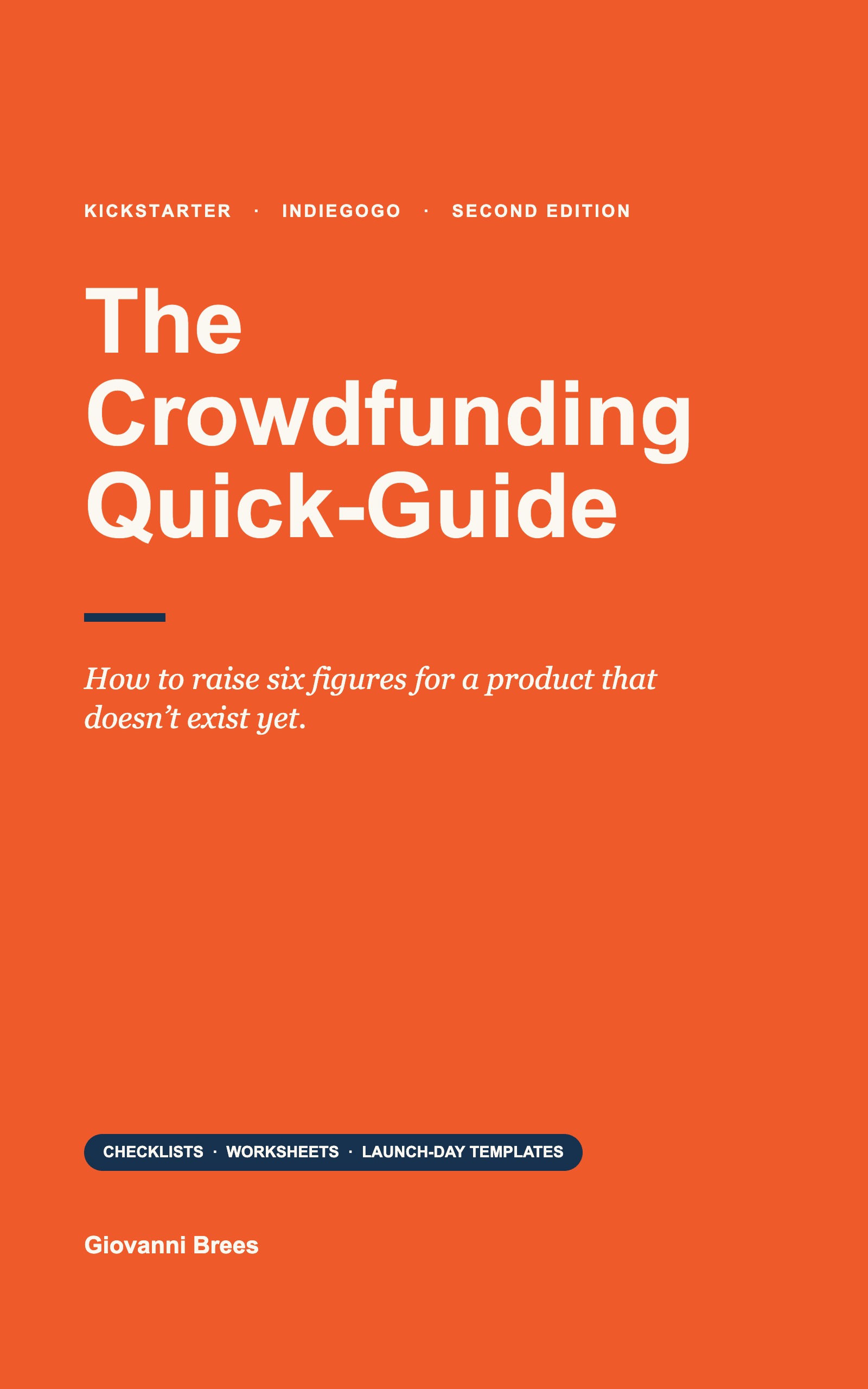
31 chapters, 7 appendices, and a checklist at the end of every one.
Get the book on Amazon →How the discovery algorithm actually works
Both platforms use algorithms to decide which projects get discovery traffic, meaning the organic visitors who land on your page without you paying for them. Understanding the basics changes how you approach launch day and the first week.
The main signal both platforms watch is momentum: how quickly you are funding relative to your goal, and how many people are backing per day. A campaign that hits 100% on day one gets flagged as interesting. A campaign sitting at 15% after a week does not. This is why funding fast matters so much. It is not just good optics for the next visitor. It unlocks platform promotion you cannot buy.
{{ momentumSvg }}On Kickstarter, campaigns that fund quickly and keep up healthy backer volume end up in category newsletters, Projects We Love features, and the trending lists new visitors browse. That free traffic can be significant. Some of the best-performing campaigns I have worked on got 20 to 30% of total revenue from organic platform traffic after the initial funded-fast spike. But it only arrives after you have proven momentum. The platform is not going to promote a campaign that hasn't demonstrated people want it.
Indiegogo works similarly, with the added benefit of an editorial team you can actually reach. If you are launching there, contact the creator team at least two weeks before launch with your project summary, your pre-launch metrics, and your expected funding pace. A featured placement in launch week can move the needle. Don't wait to be discovered. Reach out.
What editorial teams are looking for
Getting featured, whether that is Projects We Love on Kickstarter or newsletter placement on Indiegogo, can drive hundreds or thousands of organic backers with zero extra spend. It can't be bought and it doesn't happen automatically. But it can be earned, and knowing what earns it changes how you build your page.
They want a product that is genuinely interesting, or a significantly better version of something that exists. A polished campaign page that makes the platform look good. Strong early momentum. A compelling story behind the product. Photography that works and a video that holds attention. Contact creator support on your chosen platform at least two weeks out, introduce the project, and ask about editorial consideration. Nobody will promise anything. But a well-presented pre-launch pitch puts you on their radar before the algorithm has even seen you.
How long should the campaign run?
Thirty days is the sweet spot for most product campaigns. It is long enough to capture the two high-conversion windows, the first few days and the final 48 hours, without the long, demoralizing mid-campaign slump that plagues 60-day runs. The data is consistent: shorter campaigns outperform longer ones on a per-day basis because the compressed timeline keeps urgency alive throughout.
{{ durationSvg }}Some creators go as short as 21 days, especially with a strong pre-launch list and a desire to maximize scarcity. Some go 45 when they have a longer PR cycle or a product that benefits from a slower build. Start at 30 unless you have a specific reason not to. After one campaign you will have your own data, and you can calibrate the next one from that instead of from mine.
Whatever length you pick, plan for the shape of the curve. Roughly a third of your total typically arrives in the first three days, a third in the final three, and the remaining third is spread thinly across the middle. The middle is where your updates, your press, your ads and your stretch goals do their work. Nobody survives the middle on momentum alone.
Countries, eligibility and the Stripe Atlas route
Both platforms run payments through Stripe, so your home country needs to be one Stripe supports. Kickstarter currently covers around 22 countries including the US, UK, Canada, Australia, most of Western Europe, Hong Kong, Singapore, Mexico and Japan. Indiegogo has a similar footprint. Check each platform's current eligibility page, because the list changes and I don't want to hand you a number that is out of date by the time you read this.
If your country isn't on the list, you are not necessarily stuck. Stripe Atlas lets you incorporate a US company and open a US business bank account online, from anywhere, for a one-time fee of around $500. With a US entity and account, both platforms open up. It is an extra step with real tax implications, so run it past a local accountant before you set it up. But if you are serious about crowdfunding and outside the supported list, it is worth exploring.
Three platform mistakes that cost real money
Choosing the platform before building the list. I get this email every week: "We're launching on Kickstarter in three weeks, which ads should we run?" The platform is settled, the launch date is set, and there is no email list. At that point the platform choice is irrelevant, because neither algorithm is going to notice a campaign that limps to 12% in week one. The order is list first, platform second, date last.
Setting the goal for the platform instead of for the campaign. Because both platforms are all-or-nothing, some creators set a tiny goal to guarantee a "funded" badge, then wonder why the algorithm ignores a campaign that hit 100% of $2,000. Others set the real production cost as the goal and stall at 40%. The goal should be the smallest number that lets you deliver, and one your pre-launch list can clear in the first 48 hours. That is a Chapter 7 conversation, but it starts here.
Treating late pledges as an afterthought. Native late pledges mean the campaign page keeps selling after the clock stops. Creators who plan for that, with a price step-up, a fresh update, and a second wave of ads pointed at the late-pledge page, routinely add 10 to 25% to their total. Creators who switch it on and walk away get a trickle. Build the post-campaign plan before launch, not after.
A note on the smaller and regional platforms
Beyond the names above there is a long tail of regional and niche platforms: country-specific sites in Europe and Asia, platforms focused on music, publishing, film or community projects. For a physical product aimed at an international audience, I rarely recommend them. The backer pools are small, the discovery mechanics are weak, and your paid traffic will convert worse on a site your buyer has never heard of. The exceptions are a product with a strongly local market, or a category where a niche platform has become the de facto home. If you are considering one, apply the same test: search the category, sort by most funded, and see whether the money is actually there.
The decision in five questions
Where are the most-funded campaigns in my category from the last two years? Search both platforms, sort by most funded, count. Money follows audiences and audiences are sticky.
Is my product a tabletop game or a miniatures project? If yes, GameFound and BackerKit are real contenders, especially for a second campaign.
Will I need hands-on support from the platform? Hardware with certification questions, international shipping complexity, a team that has never done this: Indiegogo's service reputation is worth something.
Is my country supported? If not, decide whether the Stripe Atlas route makes sense before you plan anything else.
Can I hit my goal in the first 48 hours? This is really a question about your pre-launch list, not the platform. But it is the question that decides whether any platform's algorithm will ever notice you. If the honest answer is no, the platform choice is premature. Go build the list first.
The platform is the venue. It is not the strategy. The creators who win on Kickstarter would have won on Indiegogo, and the ones who stall on one would have stalled on the other, because the outcome was decided by the crowd they built before launch day. Pick the venue that fits your buyer, then spend your energy where it actually pays: the list, the offer and the first 48 hours.
Questions people ask
Is Kickstarter or Indiegogo better for a product launch?
Kickstarter is the larger platform with the stronger discovery algorithm and is the default for most product campaigns. Indiegogo wins on customer support and suits hardware and international audiences. Both are now fixed, all-or-nothing, with native late pledges, so choose on where your buyer already backs things.
Does Indiegogo still offer flexible funding?
No. Indiegogo retired flexible funding, so both major platforms are all-or-nothing. If you miss the goal in your window, backers are not charged and you keep nothing. Fixed campaigns have always succeeded more often because backers trust a real target.
When should I use GameFound or BackerKit instead of Kickstarter?
For tabletop games and miniatures, especially a second campaign with an existing backer community. GameFound's integrated pledge manager and optional buy list suit complex game pledges. For a first campaign with a small list, Kickstarter's discovery traffic usually matters more.
How long should a crowdfunding campaign run?
Thirty days for most product campaigns. It captures the two high-conversion windows, the first 72 hours and the final 48, without the long mid-campaign slump of 60-day runs. Go 21 days with a strong list, 45 with a long press cycle.
How does the Kickstarter algorithm decide what to promote?
It reads momentum: how fast you fund relative to goal and how many backers pledge per day. Campaigns that hit 100% on day one are flagged for newsletters, trending lists and Projects We Love. That free traffic can be 20 to 30% of total revenue, but only after momentum is proven.
Can I run a Kickstarter if my country is not supported?
Often yes. Stripe Atlas lets you incorporate a US company and open a US business bank account online for around $500. With a US entity both platforms become accessible. Check the tax implications with a local accountant first.
The platform is one decision. The book covers the other hundred.
Pre-launch funnel, reward tiers, funding-goal math, launch day, press, fulfillment and what comes after. With the worksheets to do it as you read.
Buy on Amazon →

Founder of BoostYourCampaign, one of the top three crowdfunding marketing agencies in the world, and author of The Crowdfunding Quick-Guide. His teams helped creators raise more than $600 million on Kickstarter and Indiegogo.