Why most crowdfunding campaigns fail, and how to be in the 37% that don't
About half a million projects have launched on Kickstarter. Roughly 37% funded. The failures rhyme. Here are the seven reasons, in the order they usually happen, and how to catch each one before launch.
About half a million projects have launched on Kickstarter since 2009. Roughly 37% of them funded. That means nearly two-thirds of the people who pressed launch, with a product they believed in, did not reach their goal. Having watched thousands of campaigns from the inside, I can tell you the failures rhyme. The same seven mistakes account for almost all of them, and every one is preventable.
This article goes through them in the order they usually happen, from the decision made months before launch to the one made months after. Think of it as the pre-flight check. If you can honestly say none of these applies to you, you are already in rare company.
1. No audience before launch
This is the campaign killer nobody talks about loudly enough. I have watched genuinely brilliant products get 3% funded and sit there for 30 days. Not because the product was wrong. Because the creator believed the platform would send traffic on merit. It won't, not until you have already proven momentum. The pre-launch email list, the VIP deposit group, the community built in the months before launch: that is what creates the first-day surge that tells the algorithm "show this to more people."
From the outside, this failure looks like a beautiful page with a slow counter. From the inside, it looks like a creator refreshing the dashboard and wondering where everyone is. Skip the pre-launch work and you are launching cold into a crowded marketplace. You will lose. The fix is not complicated, it is just early: build the list first, and don't set a date until the numbers say you are ready.
2. A goal set too high to hit fast
This one is a pride problem, and I say that with respect. First-time creators often set ambitious goals because they are excited and they think a big number signals confidence. It signals the opposite to backers. It signals risk. A campaign at 12% funded with 15 days left looks stuck. A campaign at 340% funded with 15 days left looks unstoppable, and the product is identical.
Set the lowest goal that still covers what you absolutely must deliver, hit it in the first 24 to 48 hours, and let momentum do the rest. Both platforms reward campaigns that fund quickly with newsletters, trending lists and editorial features. You want to be that campaign. The goal is a marketing decision with an accounting floor, not the other way around.
3. A video that doesn't show it working
More common than you would think. Founders fall in love with the brand story, the origin narrative, the beautiful cinematography, and bury the actual product demo at the 90-second mark of a three-minute video. By then 80% of viewers are gone. Show the product working in the first fifteen seconds. Grab attention first, tell the story second.
The video's job is not to be a short film. It is to create enough belief that a stranger trusts you with their card number. Do that efficiently. If the first ten seconds of your video could be the opening of any brand's ad, start again.
{{ sevenSvg }}4. A confusing or greedy offer
This happens when creators design the rewards for themselves instead of their backers. Fourteen tiers. Prices that don't round cleanly. An early bird so close to the regular price that neither feels like a deal. Bundle options that need a spreadsheet to decode. Simplify ruthlessly: three to five buying tiers, a clear retail anchor, an obvious best-value option. When a backer can understand the whole offer in one breath, they back. When they have to work to understand it, they leave.
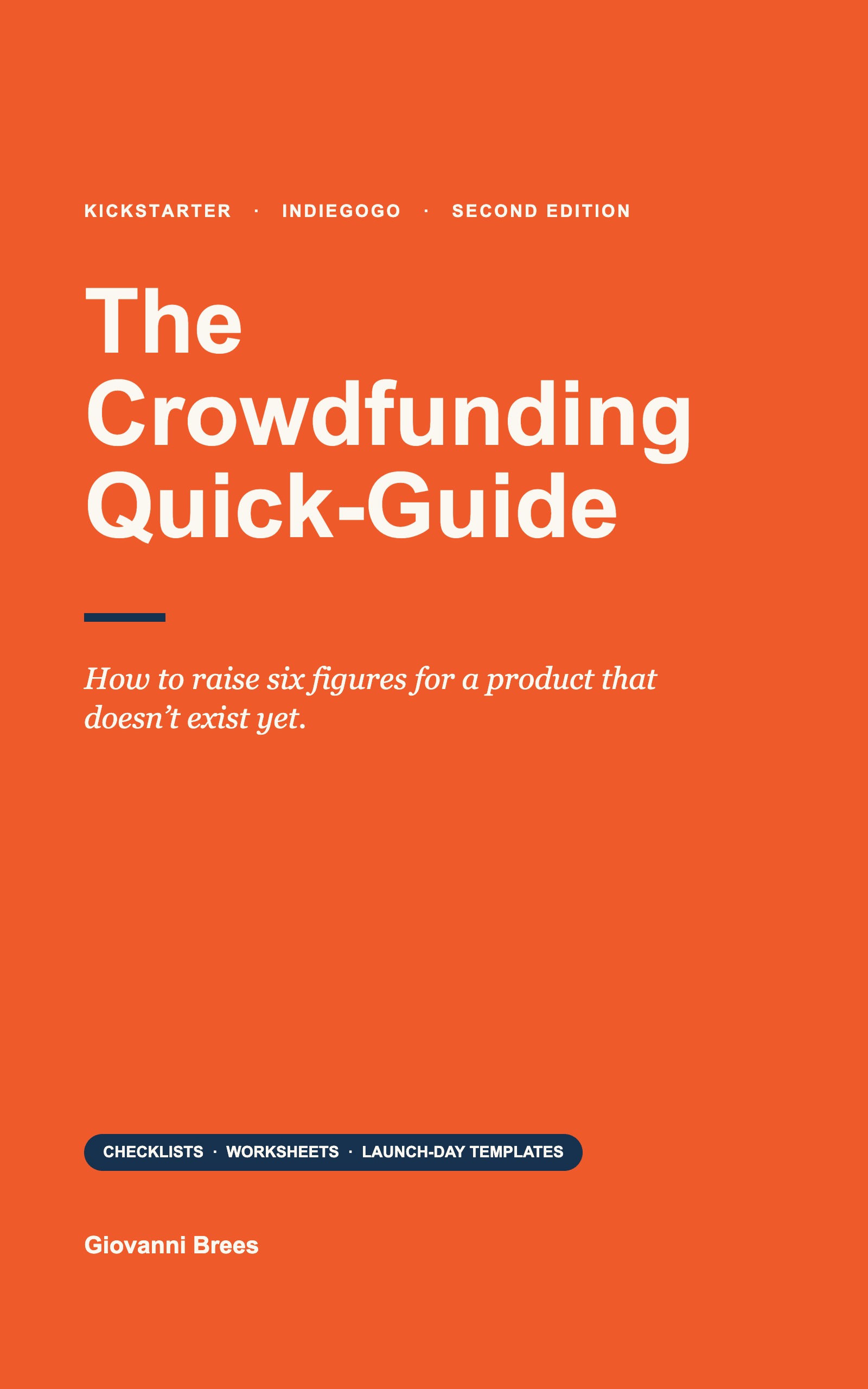
31 chapters in the order of a real campaign, so the fix arrives before the mistake does.
Get the book on Amazon →5. Funded, but no margin
The silent disaster. You hit the goal, you celebrate, and then the invoices arrive and the math stops working. Platform fees, payment processing, manufacturing at volume, international shipping, customs duties, the cost of the ads that got you there. Add them up. If the result is zero margin or worse, you are now legally obligated to deliver a product you cannot afford to deliver. This is how funded campaigns become refund disasters.
Do the per-unit math before you publish a single tier price. Cost one unit at your lowest tier: manufacturing, packaging, freight, duty, fulfillment, the shipping you are not charging for, and about 8% in fees. What is left is your margin at the early-bird price. If that number is negative, the fix is a smaller discount or a smaller cap, and backers will never notice the difference. They notice whether the offer is clear, not whether it is 35% or 40% off.
{{ marginSvg }}6. Going silent mid-campaign
An understandable mistake. Launch week is exhausting, and once the initial surge calms down it is easy to think the work is done. It isn't. Every campaign update lands in every backer's inbox. Every milestone announced, "we just crossed 500 backers," reminds people the project is alive and gives them a reason to share. Every comment you reply to tells the algorithm and the next visitor that this is a real, engaged creator.
Stay visible. Post updates weekly at minimum. Reply to every comment for the first four weeks. The mid-campaign lull is where momentum is either maintained or lost, and losing it in the middle is very hard to recover from in the final 48 hours.
7. The fulfillment disaster
The most heartbreaking failure, because it happens after you have won. You funded. You built the thing. And then delivery falls apart: products arrive damaged, shipping costs blow the budget, the manufacturer is six months late, backers are furious and leaving public reviews that poison every future campaign.
The fix is all before launch. Get the signed-off sample. Get freight quoted for your real box and weight to your top five countries before you set prices. Use a pledge manager. Pad the delivery date. And when anything changes, say so first. Backers forgive delays that are explained honestly far more readily than silence followed by a problem they discover on their own.
The order matters
Notice the sequence. The first two failures happen before launch and decide whether anyone shows up. The next two happen on the page and decide whether the people who show up convert. The fifth is decided in a spreadsheet before launch and discovered after. The last two happen in the weeks and months after the button goes live. Most creators spend their energy on numbers three and four, the video and the page, because those are the visible, creative parts. The campaigns that fund spent it on one, two and five, which are the invisible, numerical parts. That is the whole difference.
The pre-flight check
Before you set a launch date, answer these honestly. Do I have a pre-launch list with a measured deposit rate, and does the math say it can clear the goal in 48 hours? Is the goal the lowest beatable number, not the number I would like to raise? Does the product appear working in the first fifteen seconds of the video? Can I say the whole offer in one breath? Have I costed one unit at the lowest tier, including freight, duty and fees, and is the margin positive? Are the first four weeks of updates scheduled and is someone assigned to the comments? Do I have a signed-off sample, a freight quote, a pledge manager and a padded delivery date on the page?
Seven yeses and you are ready. Any no, and you have found your next job, which is far cheaper to do now than after launch.
If your first campaign didn't fund
One last thing about failure. The 63% of campaigns that don't fund are not full stops. Some of the best campaigns I have ever seen came from creators who launched too early, learned exactly what wasn't working, rebuilt their positioning and their pre-launch strategy, and launched a second time to a result that looked like overnight success to everyone watching. The first attempt was tuition: specific, actionable, public tuition that told them exactly what to change.
That is more valuable than any survey or focus group. If your first campaign doesn't fund, you haven't failed. You have run the most honest market test available. The creators who give up after a missed first campaign are the ones who paid the tuition but didn't take the course. Do the post-mortem, change what the data tells you to change, and run it again.
The failures that hide inside success
Two of the seven happen to campaigns that look funded on the dashboard. A campaign at 180% with no margin is a failure that has not arrived yet. A campaign that funds and then ships eight months late with a broken component is a failure that arrives with a thousand one-star comments attached. Both are more damaging than a campaign that simply did not fund, because the creator is now legally and reputationally on the hook. If you only read one section of this article twice, read five and seven.
The common thread in both is that the decision was made before launch and discovered after. The margin was decided when the tier prices were typed in. The fulfillment disaster was decided when the freight quote was skipped and the delivery date was set to the most optimistic month. Neither can be fixed with a better launch day.
What the 37% have in common
It is tempting to assume the campaigns that fund have better products. Having seen thousands of both, I do not think that is the main difference. The funded campaigns built an audience before launch and could name their deposit rate. They set a goal they knew they could clear. They showed the product working before they told the story. They had an offer you could repeat back after one reading. They had a unit cost sheet with a positive number at the bottom. They posted an update every week and answered every comment. And they had a sample, a freight quote and a padded date before they pressed go.
None of that is talent. It is sequence. The book is organized in that sequence for exactly this reason: so each decision arrives before the mistake it prevents. If you do the chapters in order, the seven failures become seven boxes you have already ticked, and you launch into the third of campaigns that fund with the odds, for once, on your side.
A note on the numbers by category
The 37% is an average across everything that has ever launched, and categories differ. Tabletop games fund at a much higher rate because the community is built in and reviewers do a lot of the pre-launch work. Technology and hardware fund less often, because the goals are higher, the delivery risk is real and backers have been burned before. Food, fashion and publishing sit somewhere in between. Use your category's rate as the starting point for your planning, not the headline average. And remember that the rate measures campaigns that reached their goal, not campaigns that delivered a product and made money. The second number is lower still, and it is the one this article is really about.
Questions people ask
What percentage of Kickstarter campaigns succeed?
Roughly 37% of the approximately half a million projects launched on Kickstarter have reached their funding goal. Nearly two-thirds do not. Success rates are higher in categories like tabletop games and lower in technology and food.
What is the number one reason crowdfunding campaigns fail?
No audience before launch. Creators assume the platform will send traffic on merit, but discovery traffic arrives only after momentum is proven. Without a pre-launch email list and VIP deposits, a campaign launches cold into a crowded marketplace and stalls.
Is it better to set a low or high Kickstarter goal?
The lowest goal that still covers what you absolutely must deliver, and that your list can clear in the first 24 to 48 hours. A campaign at 340% looks unstoppable; one at 12% with 15 days left looks stuck. Fast funding unlocks platform promotion you cannot buy.
Why do funded campaigns still fail?
Usually margin or fulfillment. Fees, manufacturing at volume, freight, duties and ad costs were never added up before prices were published, so the creator is legally obligated to deliver something they cannot afford. Or delivery falls apart: late, damaged, over budget, and silent.
What should I do if my crowdfunding campaign fails?
Treat it as the most honest market test available. Do the post-mortem: which of the seven failures happened, and what did the numbers say? Rebuild the positioning and the pre-launch list, then launch again. Many second campaigns look like overnight successes to everyone watching.
How do I avoid going silent mid-campaign?
Schedule updates weekly at minimum, reply to every comment for the first four weeks, announce milestones and stretch goals with proper updates, and keep press follow-ups and cross-promotions running. The middle is where momentum is kept or lost.
Nearly two-thirds of campaigns don't fund. The book exists so yours isn't one of them.
USP, pre-launch funnel, platform, pricing, the page, launch day, press and fulfillment. With a checklist at the end of every chapter.
Buy on Amazon →

Founder of BoostYourCampaign, one of the top three crowdfunding marketing agencies in the world, and author of The Crowdfunding Quick-Guide. His teams helped creators raise more than $600 million on Kickstarter and Indiegogo.